Turning Our Backs on the Sea
A mixed-media illustration exploring humanity’s relationship with the ocean, biodiversity loss, and the species that depend on healthy marine ecosystems.
Year
2026
Medium
Ink, colored pencils, and collage on paper
Dimensions
50 × 35 cm (19.7 × 13.8 in)
Status
Available
The title of this artwork was inspired by a phrase I often heard while living in Santa Marta, Colombia, in late 2025: we live with our backs to the sea. It reflects a paradox that stayed with me—despite living in coastal cities, we often remain disconnected from the ocean and fail to recognize how deeply our well-being depends on it.
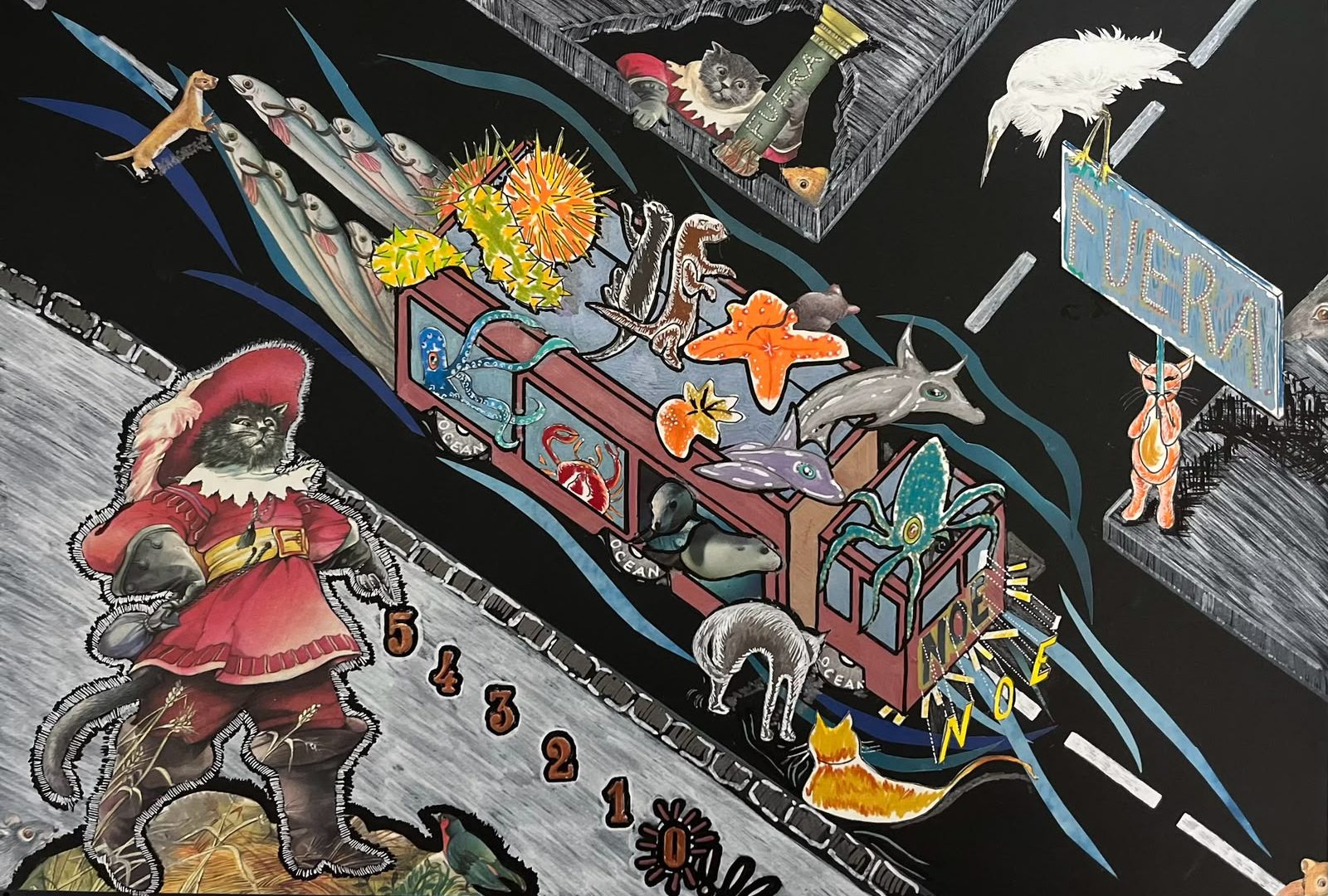
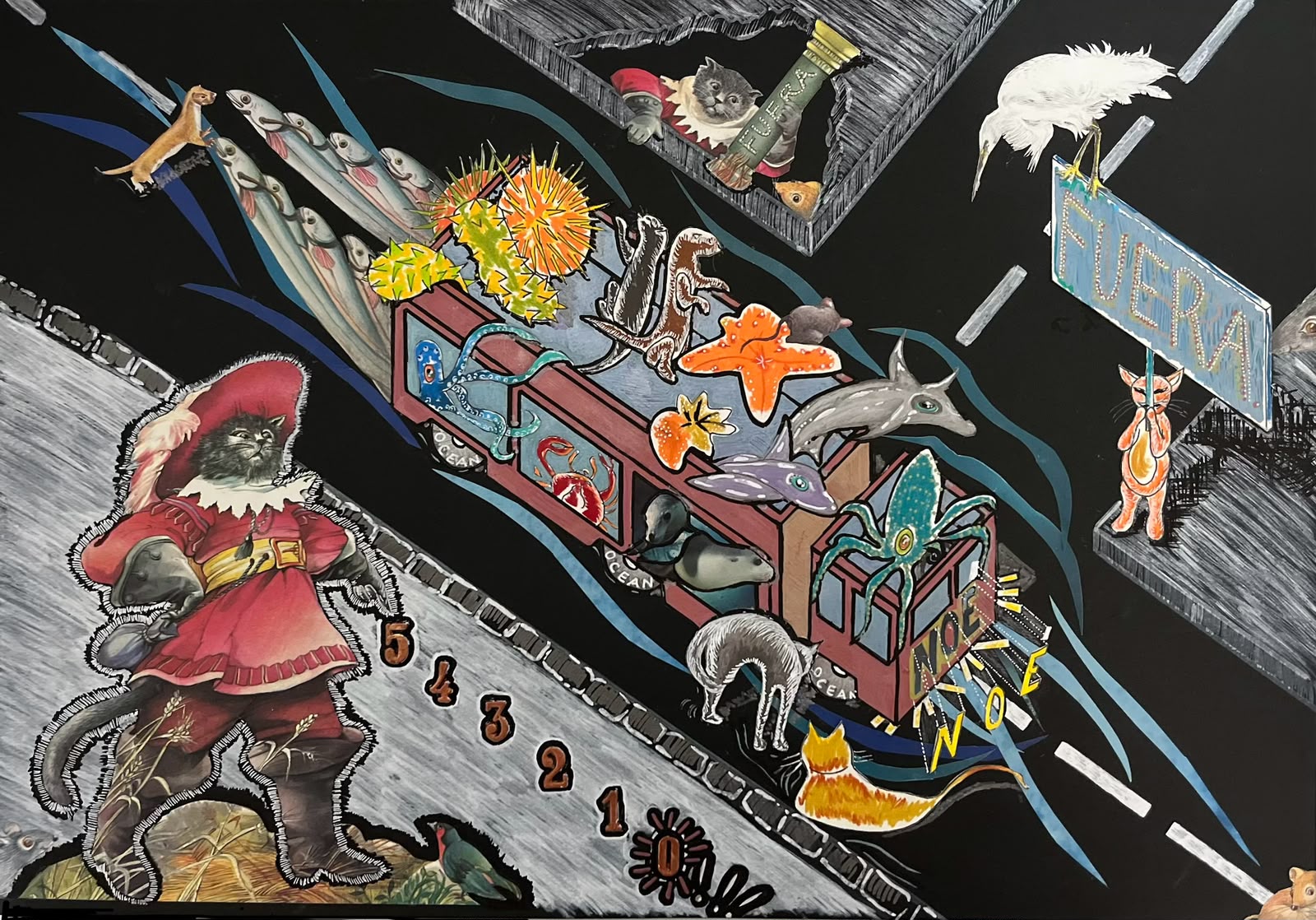
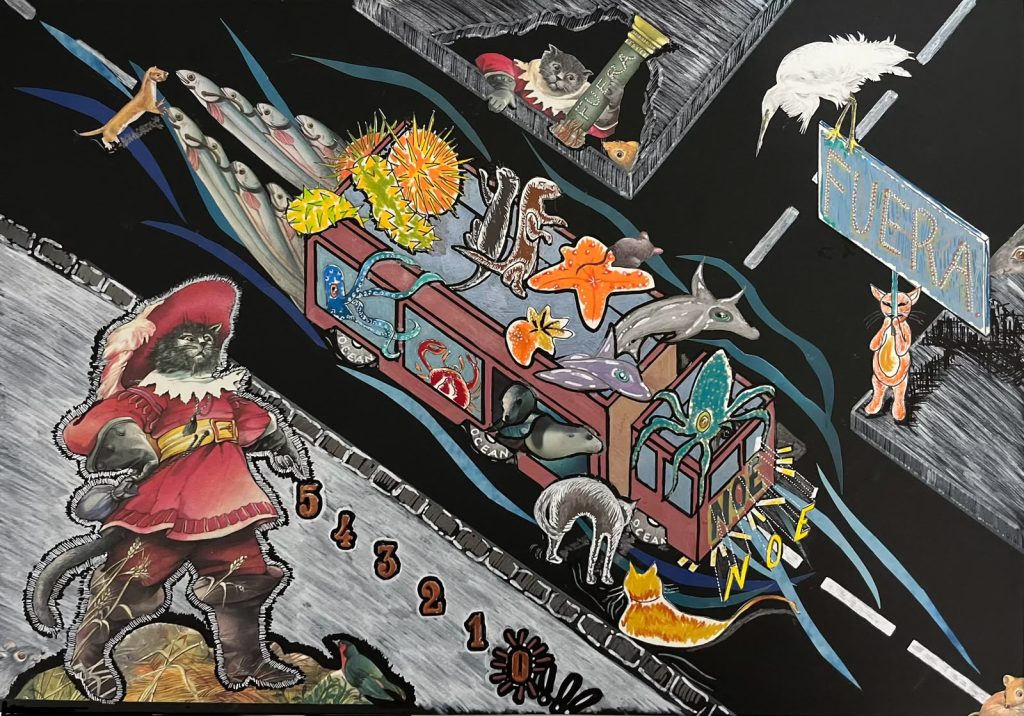
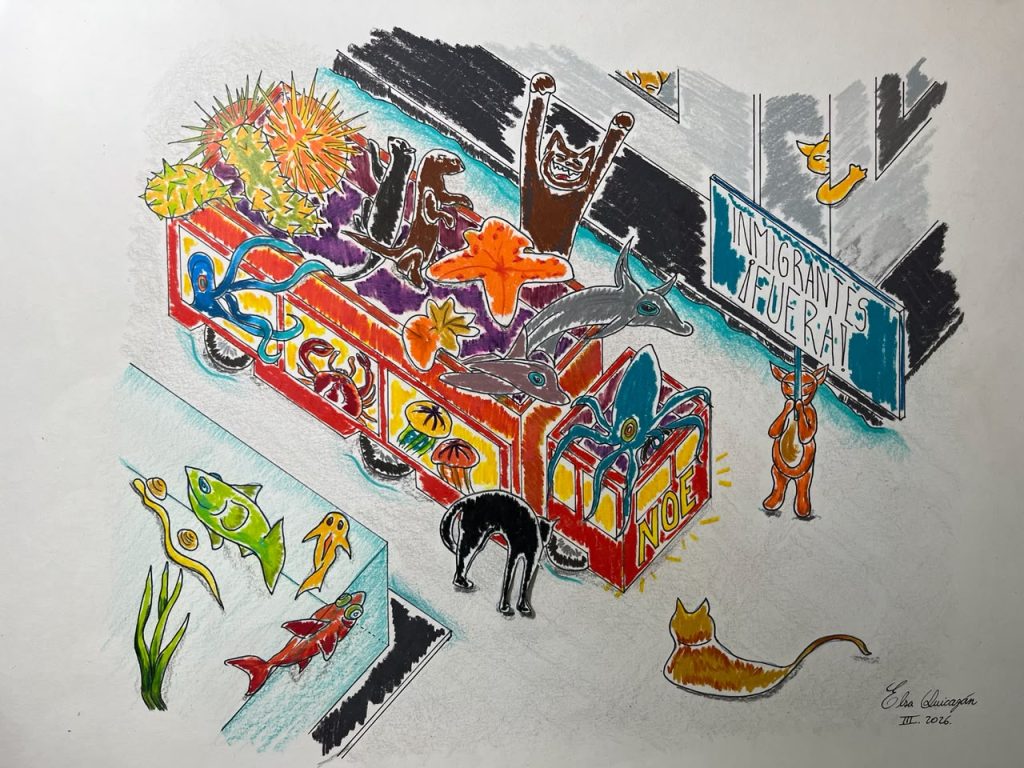
The illustration began as a classroom exercise in parallel perspective with the prompt aquatic animals living on land. I imagined a bus as a modern version of Noah’s Ark, carrying marine animals fleeing a crisis in the ocean. Upon reaching land, however, they discovered they were not welcome. The cats, among the most familiar urban animals, became the ones asking them to leave.
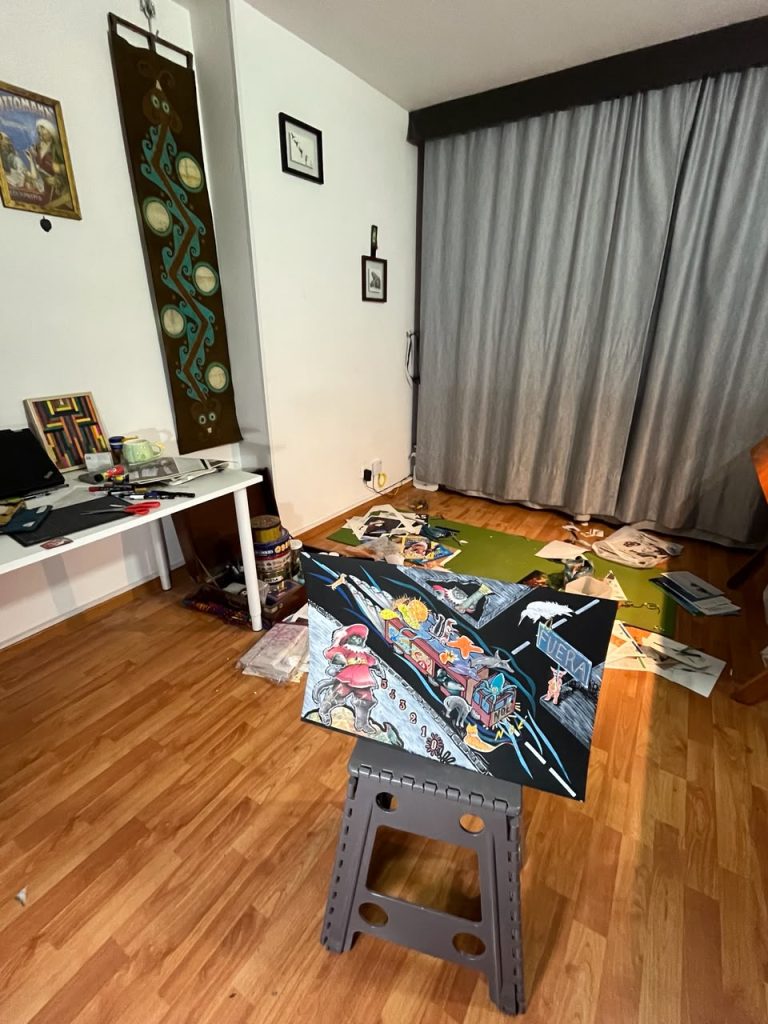
Months later, I revisited the piece for another assignment inspired by biblical scenes. Using collage, I expanded the story by introducing new characters and adding a countdown at the center of the composition—a reminder that biodiversity loss is not a distant possibility, but an unfolding crisis.
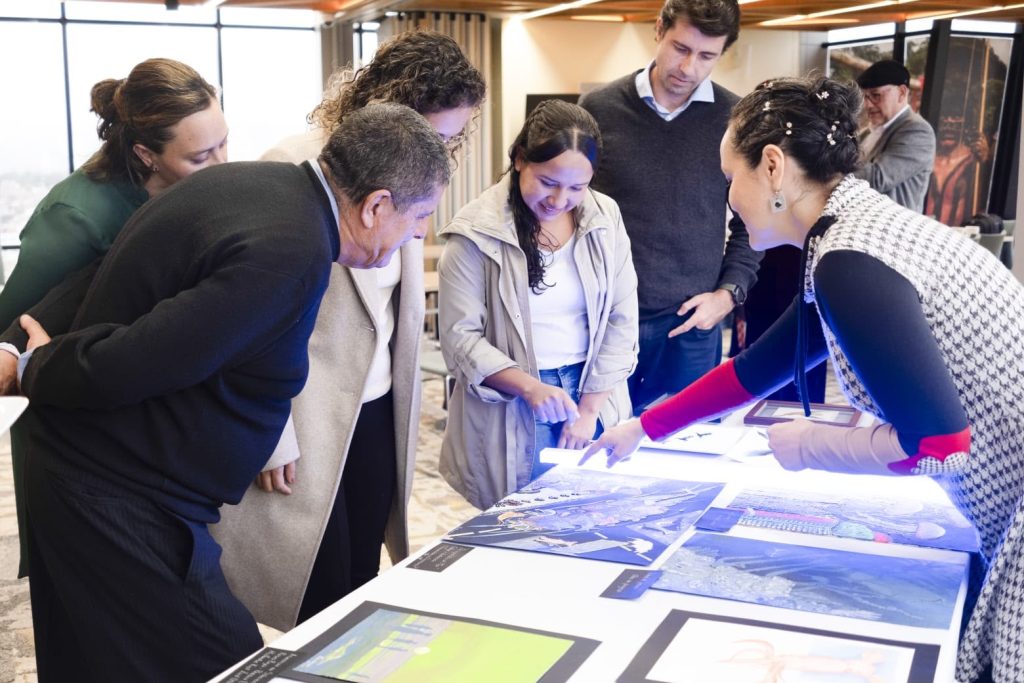
In 2026, the artwork was exhibited during the presentation of the Draft Report on Socio-environmental Assessment and Marine Spatial Planning for Offshore Wind Energy in Colombia, organized by EEMa Colombia (Colombian Offshore Wind Energy Association). Sharing it in that context reflected something central to my artistic practice: science helps us understand the ocean, while art helps us build an emotional connection to it. Visitors were also invited to search for five hidden mice, turning the artwork into a slower and more playful exploration of its many details.
This artwork evolved throughout the first semester of the Complete Illustration Program at Casatinta across the Counterperspective module with Electrobudista (Beto), the Illustration Theory & Practice module with José Rosero, and the Collage module with Red Collage.
Interested in acquiring this artwork?
This original artwork is currently available for acquisition.
For availability, pricing, shipping, or additional photographs, please contact:
📧 bioinspirada@gmail.com
🌿 Nature Inspiration
The animals in this artwork were chosen for the ecological relationships they represent.
Marine animals become unexpected travelers, symbolizing species forced to leave habitats that can no longer sustain them. The heron depends on healthy wetlands and coastal ecosystems, while the rats reflect environments shaped by human activity. A small carnivorous mammal reminds us that predators, too, rely on balanced ecosystems.
Rather than competing crises, climate change and biodiversity loss are deeply interconnected. Scientists increasingly recognize that neither can be addressed without the other. Healthy oceans regulate climate, produce oxygen, support fisheries, sustain biodiversity, and ultimately make human life possible.
Turning Our Backs on the Sea invites us to reconsider our relationship with the ocean. Whether we live on the coast or far inland, our future remains inseparable from the health of marine ecosystems.
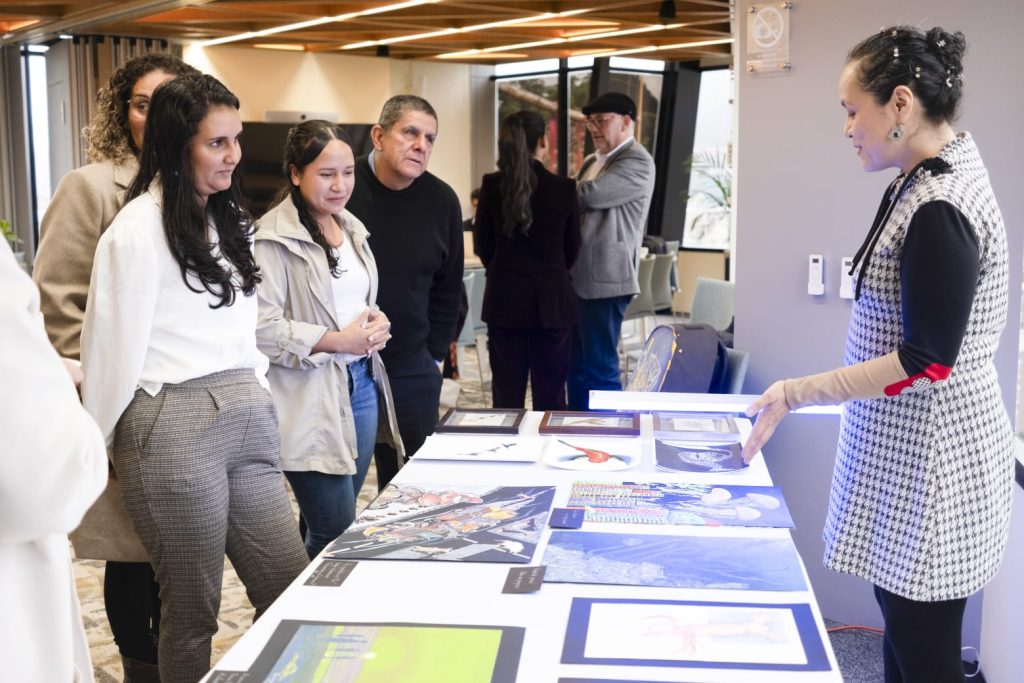
Visitors exploring the artwork during the EEMA exhibition.